
About CRI
The FAS Center for Regulatory Ingenuity (CRI) is building a new, transpartisan vision of government that works — that solves complex challenges like climate change in ways that improve people’s daily lives.
Government is essential to a functioning economy and healthy society, but over time often becomes overly bureaucratic and disconnected from the people it’s meant to serve.
There is an increasingly obvious mismatch between modern problems and the aging institutions and regulatory strategies we rely on to solve them. Public trust in government is in the basement as a result.
The FAS Center for Regulatory Ingenuity (CRI) is charting paths for a renewed administrative state and a more responsive government in the U.S.
We work by:
- Creating high-trust environments where different stakeholders can pressure-test the big ideas needed to modernize government institutions and the democratic feedback loops that hold them accountable.
- Cultivating a “network of networks” that helps policymakers and practitioners move these ideas from concept to implementation at scale.
Climate As An Anchor
Our focus is on climate policy: a space where mismatches between the tools we have and tools we need are particularly apparent. Foundational environmental statutes like the Clean Air Act and Clean Water Act were designed to curb industrial pollution, not guide the society-wide economic transition to clean technologies that’s underway. Many government agencies and processes are similarly outdated.
Successfully navigating the transition to a clean economy means updating 20th-century laws and institutions for a 21st-century world. It means expanding the climate toolbox with creative, clever strategies — like forcing big companies to be more transparent about how they set prices for zero-emission technology, or equipping public utility commissions with “main character energy” — that effectively complement regulation. It means taking people seriously when they say what they want government to deliver, and focusing on solutions that respond to the everyday needs of Americans while also making progress on climate goals. It means resisting the temptation to chase buzzwords — from “abundance” to “dominance” to “affordability” — and focusing on the method over the message.
Theory Of Change
CRI operates on a three-part theory of change, with each part underpinned by a relentless focus on bridging policy development and policy implementation.
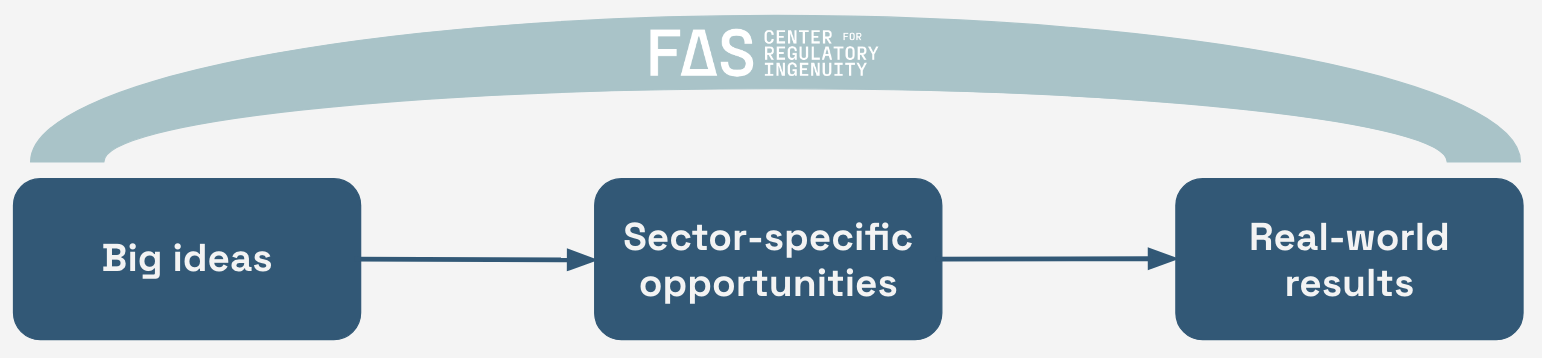
First, we’re laying out the big ideas that should underpin the next era of climate policy. We’re exploring questions like: How do we position affordability at the center of a reset climate agenda? Can public participation be easier and more meaningful? How can we make much better use of tools like public finance and industrial policy? These are questions that won’t be answered today, but that a forward-looking climate agenda must take seriously.
Second, we’re mapping these big ideas to sector-specific opportunities. Energy, housing, and transportation collectively account for two-thirds of U.S. emissions, and also matter deeply to politicians and the public. CRI is exploring how creative, clever regulatory approaches can drive rapid, equitable, and durable decarbonization in each of these sectors — and how near-term action at the state and local level can lay the foundation for accelerated progress in the future.
Finally, we’re putting sector-specific playbooks into the hands of people who can deliver real-world results. CRI is identifying and engaging networks of motivated state, local, and private actors who are eager to lead a next climate era. We’re working across red, blue, and purple geographies to move from ambition to action, demonstrating that government can do great things for our communities and our planet.
Why FAS?
The Federation of American Scientists (FAS) has a legacy of driving progress on seemingly intractable issues. Through our decades of experience advancing science in the public interest, we’ve developed deep relationships that span ideologies and sectors; through our ethos of “policy entrepreneurship”, we’re adept at leveraging internal and external expertise to shape society for the better. Our work has recently shaped more than $5 billion in public spending, inspired major federal projects like ARPA-I and DOE’s Earthshots, informed law and policy on everything from wildfire to global risk, and served as an incubator for initiatives that have gone on to be self-sustaining and impactful. The Center for Regulatory Ingenuity builds on FAS’s established programs in climate and environment and government capacity to meet a unique moment in the arc of climate action.